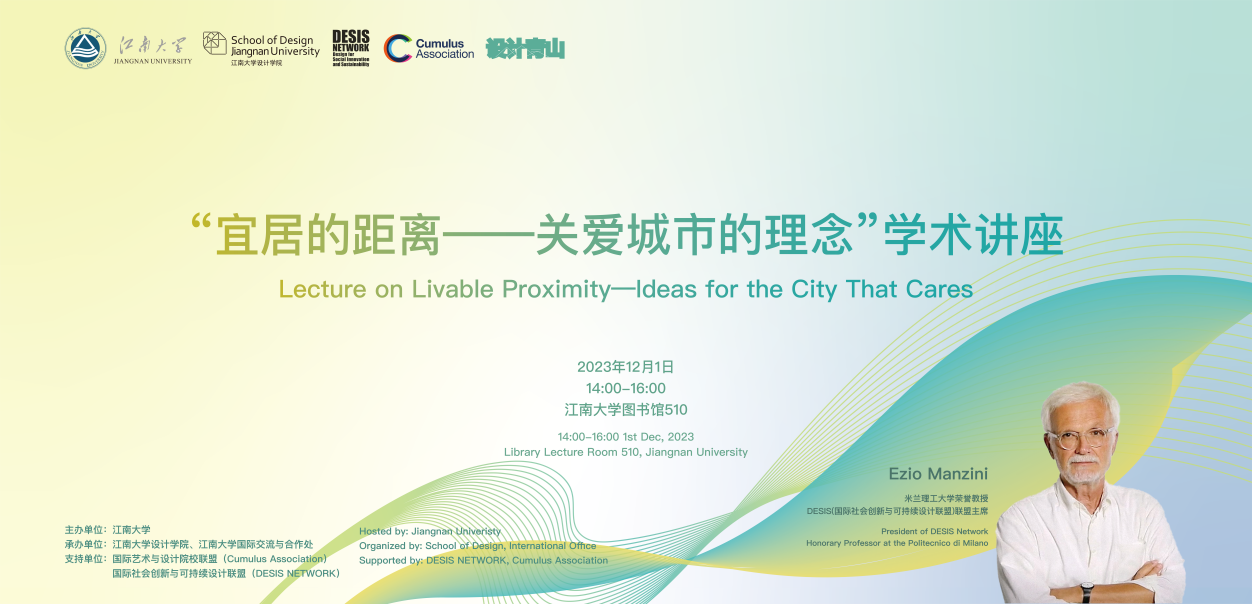
時間:2023年12月1日 下午2:00-4:00
地點:江南大學圖書館5樓510報告廳
主辦單位:江南大學
承辦單位:威尼斯歡樂娛人城v3676����、江南大學國際交流與合作處
支持單位:國際藝術(shù)與設(shè)計院校聯(lián)盟(Cumulus Association)����、國際社會創(chuàng)新與可持續(xù)設(shè)計聯(lián)盟(DESIS NETWORK)
講座嘉賓:EzioManzini教授
嘉賓簡介:
EzioManzini教授為意大利米蘭理工大學榮譽教授���,國際社會創(chuàng)新與可持續(xù)設(shè)計聯(lián)盟(DESISNETWORK)創(chuàng)始人及主席�����,三十多年來���,他一直從事可持續(xù)設(shè)計領(lǐng)域的工作��,榮獲意大利工業(yè)設(shè)計界最高榮譽獎“金羅盤獎”終身成就獎�;在過去十年中,他還曾在倫敦藝術(shù)大學����、埃利薩瓦設(shè)計工程學院���、同濟大學、帕森斯-新威尼斯歡樂娛人城v3676(NYC)等全球多所大學的威尼斯歡樂娛人城v3676擔任客座教授�����。因?qū)洗髮W在內(nèi)的江蘇省內(nèi)相關(guān)學科領(lǐng)域的突出貢獻�,Ezio Manzini教授獲得“江蘇友誼獎”���。
講座主題:宜居的距離-關(guān)愛城市的理念
Livable proximity: Ideas for the city that cares
講座內(nèi)容摘要:
在過去的一個世紀里�����,現(xiàn)代社會的空間組織一直受到以專業(yè)化和規(guī)模經(jīng)濟為基礎(chǔ)的效率理念的影響�����。以效率和衛(wèi)生的名義�����,一些地區(qū)已經(jīng)專門化:工作的地方、娛樂的地方����、學習的地方��、睡覺的地方��。我們可以把這一切稱為遠距離的居住�����。
然而,隨著時間的推移����,人們清楚地認識到�,這種方案正在導致非常嚴重的環(huán)境和社會問題。因此��,長期以來���,這種模式開始與其他想法和做法發(fā)生沖突,因為人們需要把分離的東西集中起來���,把斷開的東西重新連接起來。也就是說���,要把服務(wù)、工作場所和人們的家更緊密地聯(lián)系在一起�����。這些新的理念和實踐�,即這些社會創(chuàng)新,可以被視為一個新的新興方案的開端:宜居的“附近”方案����。
本講座將討論這種近距離情景����,說明它是如何從過去20年的基層社會創(chuàng)新中產(chǎn)生的�,以及在一些城市,它是如何成為一種行動參考����,有時使用“15分鐘城市”的說法��,創(chuàng)建新的近距離系統(tǒng)�����,能夠滿足公民的許多(如果不是全部)日常需求����。
講座內(nèi)容的概念背景�����,可在他最新的著作中找到:
【意】E·曼奇尼.鐘芳���、馬謹譯. 設(shè)計,在人人設(shè)計的時代:社會創(chuàng)新設(shè)計導論[M]. 北京:電子工業(yè)出版社�����,2016.
【意】E·曼奇尼.鐘芳譯. 日常的政治. 南京:江蘇鳳凰美術(shù)出版社�,2020.
【意】E·曼奇尼.劉屹,鐘芳譯. 宜居的距離. 南京:江蘇鳳凰美術(shù)出版社���,2023.
In the past century the spatial organization of modern societies has been dominated by the effects of an idea of efficiency based on specialization and economy of scale. In the name of efficiency and hygiene, some areas have specialized: those where to work, those where have fun, those where study, those where go back to sleep.We can refer to all of this as the scenario of livable distance.
Over time, however, it clearly emerged that the application of this scenario was leading to very serious environmental and social problems. Therefore, since long time some cases appeared in which this model began to clash with other ideas and practices, driven by the need to bring together what had been separated and to reconnect what had been disconnected. That is, tobring services, workplaces and people's homes closer together.These new ideas and practices, i.e. thesesocial innovations, con be seen as the beginning of a new, emerging scenario:the scenario of livable proximity.
Although the problems of the society of distance were evident since long time, until 2019, the ideas and practices that had led to the definition of the scenario of proximity have slowly advanced. Then the pandemic arrived and, paradoxically, the same sanitary distancing it required has shown everyone how important physical proximity is: the social role of neighborhood services; the advantage of working close to where you live; the importance of having good relationships with the tenants next-door. In short, the value of the scenario pf proximity has been recognized by a growing number of people and institutions
The lecture discusses this scenario of proximity, showing how it has emerged from thegrassroots social innovationsof the past 20 years, and how, in some cities, it has become a reference for action, sometimes using the expression "15-minute city, with the creation of newproximity systemscapable of responding to many, if not all, the daily needs of citizens.
The conceptual background on which the lecture is based can be found in: "Design, When Everybody Designs", MIT Press 2015, "Politics of the Everyday." Bloomsbury, 2019 and Livable Proximity (Egea, 2022);“Plug-ins: Design for City Making in Barcelona”(with Albert Fuster and Roger Paez - Elisava and Actar Publishers 2023.


 NEWS
NEWS